TSA Rules and REAL ID in 2026: What You Need at Security
What TSA requires at airport security as of October 2026: REAL ID and the IDs that replace it, the $45 TSA ConfirmID fee, ID rules for kids, the end of shoes-off screening, and the unchanged 3-1-1 liquids rule.
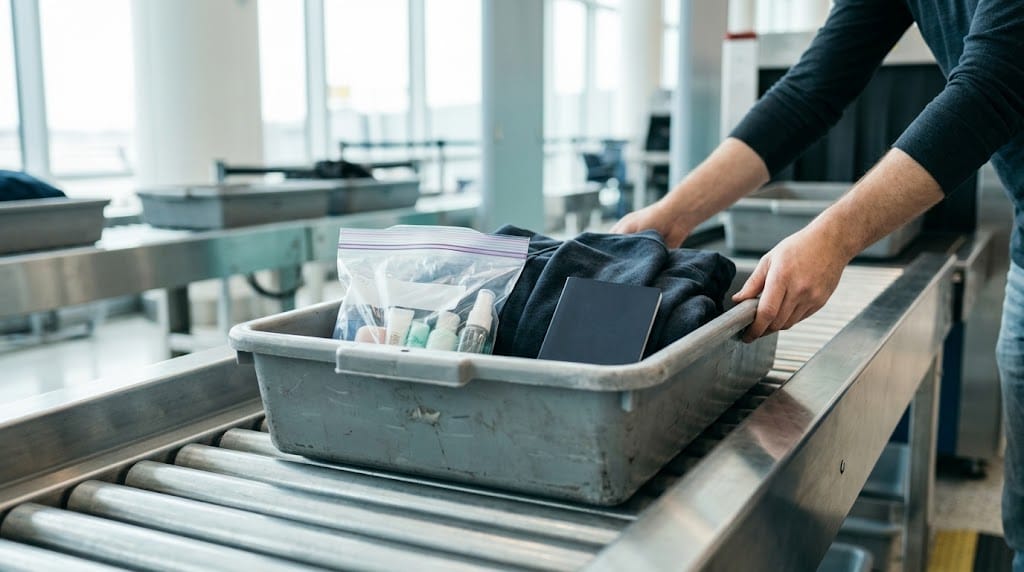
If you are flying in the United States this fall or over the holidays, the checkpoint rules have shifted more in the last 18 months than in the decade before. REAL ID enforcement started in May 2025, shoes stay on for most travelers since July 2025, and since February 1, 2026, flyers who show up without an acceptable ID can pay a $45 fee to try to verify who they are. The liquids rule, on the other hand, has not changed at all.
This guide covers what the Transportation Security Administration (TSA) requires at airport security checkpoints as of October 2026, based on TSA and Department of Homeland Security guidance, so you can pack and plan without guessing.
The short version
- ID: Travelers 18 and older must show a REAL ID or another acceptable form of identification, such as a U.S. passport, to board domestic flights within the United States.
- No acceptable ID? You can pay $45 online for TSA ConfirmID before you get to the airport. It is not guaranteed to work and it adds time.
- Kids: TSA does not require children under 18 to show ID on domestic flights.
- Shoes: Most travelers can keep shoes on. Officers can still ask you to remove them in some cases.
- Liquids: Still 3.4 ounces (100 ml) per container, all in one quart-size bag, with exceptions for medications, formula, and breast milk.
REAL ID requirements: who needs one and how to tell
The REAL ID Act, passed by Congress in 2005, set minimum security standards for state-issued driver's licenses and ID cards. Beginning May 7, 2025, TSA started enforcing it at airport security checkpoints. Since then, a standard state driver's license that is not REAL ID-compliant no longer works by itself at airport security for adults on domestic flights.
To check whether you are REAL ID ready, look for a star at the top of your license. TSA says a REAL ID-compliant card is marked with a star, and the exact design varies by state. Enhanced driver's licenses, issued by a handful of states and labeled "Enhanced," also count.
If your license has no star and does not say Enhanced, it is not REAL ID-compliant. That does not mean you cannot fly. It means you need another acceptable form of ID to board domestic flights, or you need to use ConfirmID. The same REAL ID requirements apply when you visit certain federal facilities.
How to get a REAL ID before your trip
REAL ID cards are issued by your state's driver's license agency, usually your local DMV, not by TSA. Expect an in-person visit with original documents that prove your identity, Social Security number, and address. Each state publishes its own checklist, and many let you book an appointment online. Appointments can book up weeks out before the holidays, so start now if you plan to fly in November or December.
Acceptable forms of ID at the TSA checkpoint
You do not need a REAL ID-compliant driver's license if you carry another acceptable form of ID in lieu of a REAL ID. TSA accepts several forms of identification at the checkpoint, and the most common ones are:
- U.S. passport or U.S. passport card
- DHS trusted traveler cards: Global Entry, NEXUS, SENTRI, or FAST
- U.S. Department of Defense ID, including IDs for dependents
- Permanent resident card
- Enhanced driver's license or enhanced ID card
- Photo ID issued by a federally recognized Tribal Nation
- Foreign government-issued passport
- Veteran Health Identification Card (VHIC)
TSA's full list also includes the Border Crossing Card, TWIC, HSPD-12 PIV cards, Canadian provincial driver's licenses, the Employment Authorization Card (I-766), and the U.S. Merchant Mariner Credential.
What about an expired ID?
TSA currently accepts the IDs on its list for up to two years after they expire. A passport that expired 18 months ago will still get you through security on a domestic flight. One that expired three years ago will not.
Digital IDs on your phone
TSA accepts digital IDs and mobile driver's licenses at more than 250 airports for eligible states, through Apple Wallet, Google Wallet, Samsung Wallet, or a state-issued app. You tap your phone or scan a QR code at the podium. TSA's own guidance is clear on one point: all passengers must still carry an acceptable physical ID. Treat the phone version as a convenience, not a backup.
TSA ConfirmID: the $45 fee if you have no acceptable ID
Starting February 1, 2026, travelers 18 and older who cannot present a REAL ID or another accepted ID can use TSA ConfirmID. Here is how it works, according to TSA:
- Pay before you fly. The fee is $45 per traveler, paid online through Pay.gov. TSA accepts bank account (ACH), debit card, credit card, Venmo, or PayPal.
- Check the travel date. The payment covers ConfirmID use for 10 days starting from the travel date on your receipt. Enter the right date.
- Bring the receipt. Show the printed or emailed receipt to the TSA officer at the checkpoint. TSA will then attempt to verify your identity.
- Plan for extra time. TSA says verification can take up to 30 minutes at the checkpoint, and ConfirmID travelers get additional screening.
Two cautions matter here. First, paying does not guarantee you will get through. TSA states there is no guarantee it can verify your identity, and if it cannot, you may not be allowed through security. Second, if you show up without acceptable ID and without having paid in advance, TSA warns you may face additional delays that can make you miss your flight.
The identity verification process is separate for each traveler, so each adult without acceptable ID pays separately. If two adults in your party both lack a REAL ID, that is $90 for the trip.
TSA rules for traveling with children
TSA does not require children under 18 to show identification when traveling with a companion inside the United States. Airlines can have their own rules, especially for unaccompanied minors, so check with your carrier.
At the checkpoint, TSA lets children 12 and under keep their shoes, light jackets, and hats on. Infants and small children come out of strollers and car seats and are carried through the walk-through metal detector, while strollers and car seats go through the X-ray. TSA also says children will not be separated from their parent or guardian.
Formula, breast milk, toddler drinks, and baby food are allowed in carry-ons in amounts over 3.4 ounces and do not have to fit in your quart bag. Tell the officer at the start of screening that you have them. Ice packs, freezer packs, and liquid-filled teethers are allowed too.
Do you have to take your shoes off at TSA?
For most travelers, no. On July 8, 2025, DHS and TSA announced the end of the "shoes-off" requirement at checkpoints nationwide, citing improvements in screening technology. Two exceptions are worth knowing:
- Officers can still ask you to remove shoes if you are selected for additional screening or your shoes alarm.
- Travelers using ConfirmID get additional screening, so expect extra steps at the checkpoint.
Wear shoes that come off easily anyway. It costs nothing and saves time if you are pulled aside.
The liquids rule in 2026: still 3-1-1
Despite headlines suggesting otherwise, TSA's liquids rule reads the same in October 2026 as it has for years. In your carry-on, you can bring liquids, aerosols, gels, creams, and pastes in containers of 3.4 ounces (100 milliliters) or less per item, all in one quart-size bag, one bag per passenger.
Exceptions TSA lists:
- Medications: Medically necessary liquids can exceed 3.4 ounces. Declare them to the officer for inspection.
- Infant and child nourishment: Formula, breast milk, juice, and baby food, as above.
- Duty-free liquids: On an international trip connecting in the U.S., duty-free liquids over 3.4 ounces bought within the last 48 hours are allowed if they stay in the sealed, tamper-evident bag with the receipt.
Anything that alarms during screening gets extra screening. Larger bottles of shampoo, sunscreen, or holiday gifts like perfume and maple syrup belong in a checked bag. If you are unsure about a specific item, TSA's "What Can I Bring?" search tool on tsa.gov is the fastest way to check.
Some airports now use computed tomography (CT) scanners in certain lanes, and the instructions for what to take out of your bag can differ by lane. Follow what the officer at your lane says.
Checkpoint tips for the busy holiday season
- Check your ID tonight. Look for the star on your license or find your passport, since travelers will need one of the accepted forms of ID at the TSA checkpoint. Fixing an ID problem the night before a flight is hard.
- Pay for ConfirmID early if you need it. Do it before you leave for the airport, not in the security line.
- Pack the quart bag on top. Officers may ask you to take it out.
- Keep gifts unwrapped. Wrapped gifts may need to be opened if they need inspection. Gift bags or wrapping at your destination avoid that.
- Consider TSA PreCheck. It does not replace the ID rules, but members use separate lanes at participating airports, which helps on busy travel days.
- Give yourself time. Thanksgiving week and the days around Christmas and New Year's are among the busiest of the year for TSA.
For more ways to get through the terminal faster, read our stress-free airport tips. Building your bag around the liquids rule is easier with our travel packing checklist, and ID problems are one of the common travel mistakes that can ruin a trip.
FAQ
Can I fly with a regular driver's license in 2026?
Not by itself, if you are 18 or older. Since May 7, 2025, adults need a REAL ID-compliant license or another TSA-accepted ID such as a passport. If you have neither, you can pay $45 for TSA ConfirmID before you fly, but verification is not guaranteed.
Does my child need a REAL ID to fly?
No. TSA does not require children under 18 to show ID on domestic flights when traveling with a companion. Check your airline's rules if your child is flying alone.
How long is TSA ConfirmID good for?
The $45 payment covers 10 days starting from the travel date on your receipt. If your round trip is longer than 10 days, check TSA's ConfirmID page before you pay, since you may need to plan for the return leg.
Did TSA change the 3.4-ounce liquids limit?
No. As of October 2026, the limit is still 3.4 ounces (100 ml) per container in one quart-size bag, with exceptions for medications and infant or child nourishment.
Can I use an expired passport at TSA?
Yes, for domestic flights, if it expired no more than two years ago. TSA accepts expired IDs on its list for up to two years past expiration. International travel follows different passport rules.
Sources
- TSA: REAL ID
- TSA: Acceptable identification at the TSA checkpoint
- TSA: TSA ConfirmID
- TSA press release: $45 fee option for air travelers without a REAL ID begins February 1
- TSA press release: DHS to end "shoes-off" travel policy
- TSA: Liquids, aerosols and gels rule
- TSA: Traveling with children
- TSA: Digital ID