Famous Bridges to Visit in the US and Abroad: How to Walk, Bike or See Them
Some famous bridges you can walk on any day. Others open to people on foot only once a year. The Mackinac Bridge Authority closes its 5-mile bridge to cars on Labor Day morning for the annual Bridge Walk; in 2026 that was Monday, September 7. The National Park Service says the New River Gorge Bridge deck is open to walkers only on Bridge Day, the third Saturday of October. The Golden Gate Bridge district keeps the east sidewalk open to pedestrians every day from 5:00 am. Details like these decide whether a bridge fits your trip, so they come first in each section below.
This guide covers six famous bridges in the United States and two in Europe: Golden Gate, Brooklyn, Mackinac, New River Gorge, Royal Gorge, the Old Seven Mile Bridge in the Florida Keys, Tower Bridge and Charles Bridge. For each one you get the year it opened, its size from the agency or owner that runs it, and how you can walk, bike or drive it. We took every number from the bridge operator's own website, the National Park Service or an official tourism office in late October 2026. Sidewalk hours, tolls and event dates change, so check the operator again the week you go, and plan a stop on a scenic drive around the one beautiful bridge you most want to cross.
A quick guide to bridge types
Once you have seen a few, the type of bridge tells you what to look for.
- Suspension bridge: the deck hangs from vertical cables attached to main cables that run over tall towers and anchor at each end. Golden Gate, Brooklyn and Mackinac are suspension bridges.
- Arch bridge: the load pushes down and out into the arch and the ground at each end. The New River Gorge Bridge is a single steel arch.
- Cable-stayed bridge: cables run straight from the towers to the deck, usually in a fan or harp pattern, with no main cable draped between towers.
- Cantilever bridge: arms reach out from supports and meet or carry a short span in the middle.
- Bascule bridge: part of the deck lifts to let ships through. London's Tower Bridge is the famous one.
Golden Gate Bridge, San Francisco, California
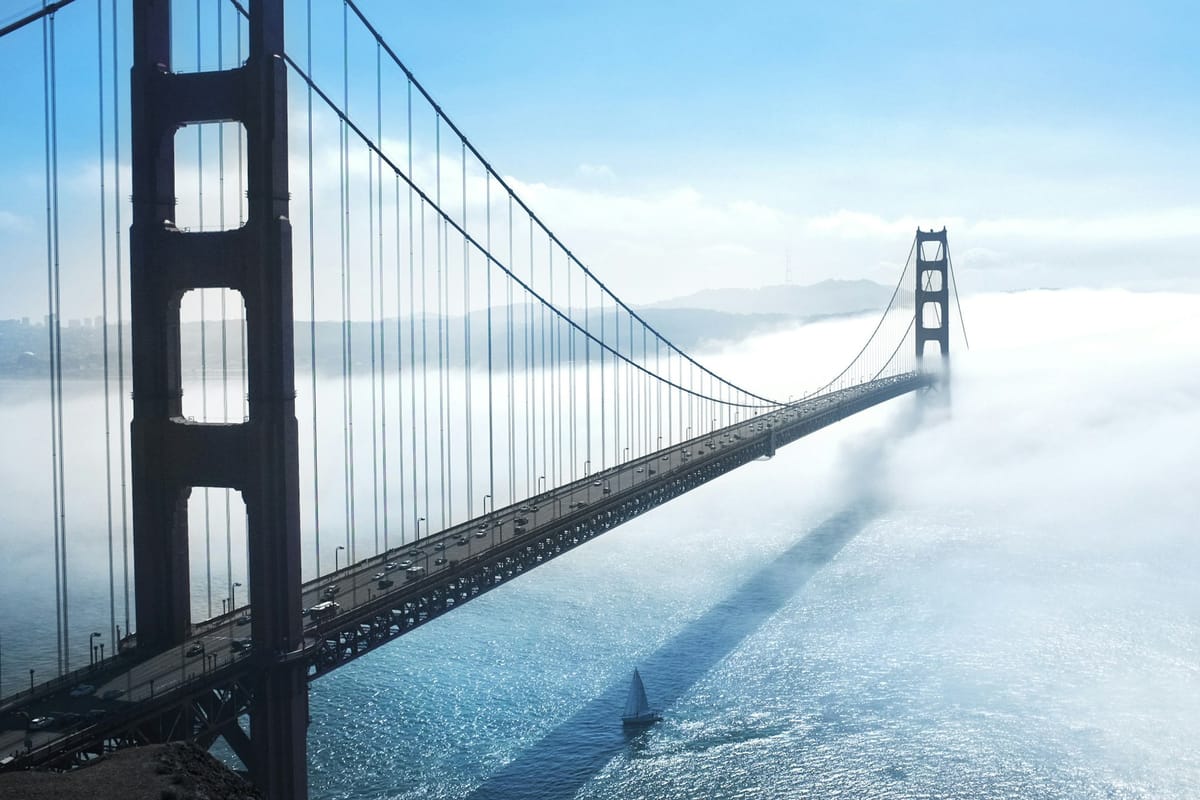
The Golden Gate Bridge opened on May 28, 1937, after a Pedestrian Day on May 27 when the whole roadway was open to people on foot. According to the Golden Gate Bridge district, the bridge is 1.7 miles long from end to end, the main span between the towers is 4,200 feet, and the towers rise 746 feet above the water. That span was the longest of any bridge in the world from 1937 until New York's Verrazano Narrows Bridge opened in 1964. The American Society of Civil Engineers named it a National Historic Civil Engineering Landmark in 1984.
- Walking: pedestrians use only the east sidewalk, the side facing San Francisco. Hours are 5:00 am to 6:30 pm in Pacific Standard Time (early November to early March) and 5:00 am to 9:00 pm in Pacific Daylight Time. The east sidewalk sometimes closes an hour early on weeknights during safety barrier construction.
- Biking: bicycles cross free at any hour, on the east or west sidewalk depending on the day and time. Cyclists must yield to pedestrians; the speed limit is 15 mph on the sidewalks and 5 mph around the towers. There are no bike rentals at the bridge.
- Driving: the toll is collected only southbound, into San Francisco, and there is no cash lane. From July 1, 2026, a 2-axle car pays $10.25 with FasTrak, $10.50 with a one-time payment or $11.25 by toll invoice.
Walking across and back is about 3.4 miles, and it is often windy and cold on the span, even in summer. Bring a layer.
Brooklyn Bridge, New York City
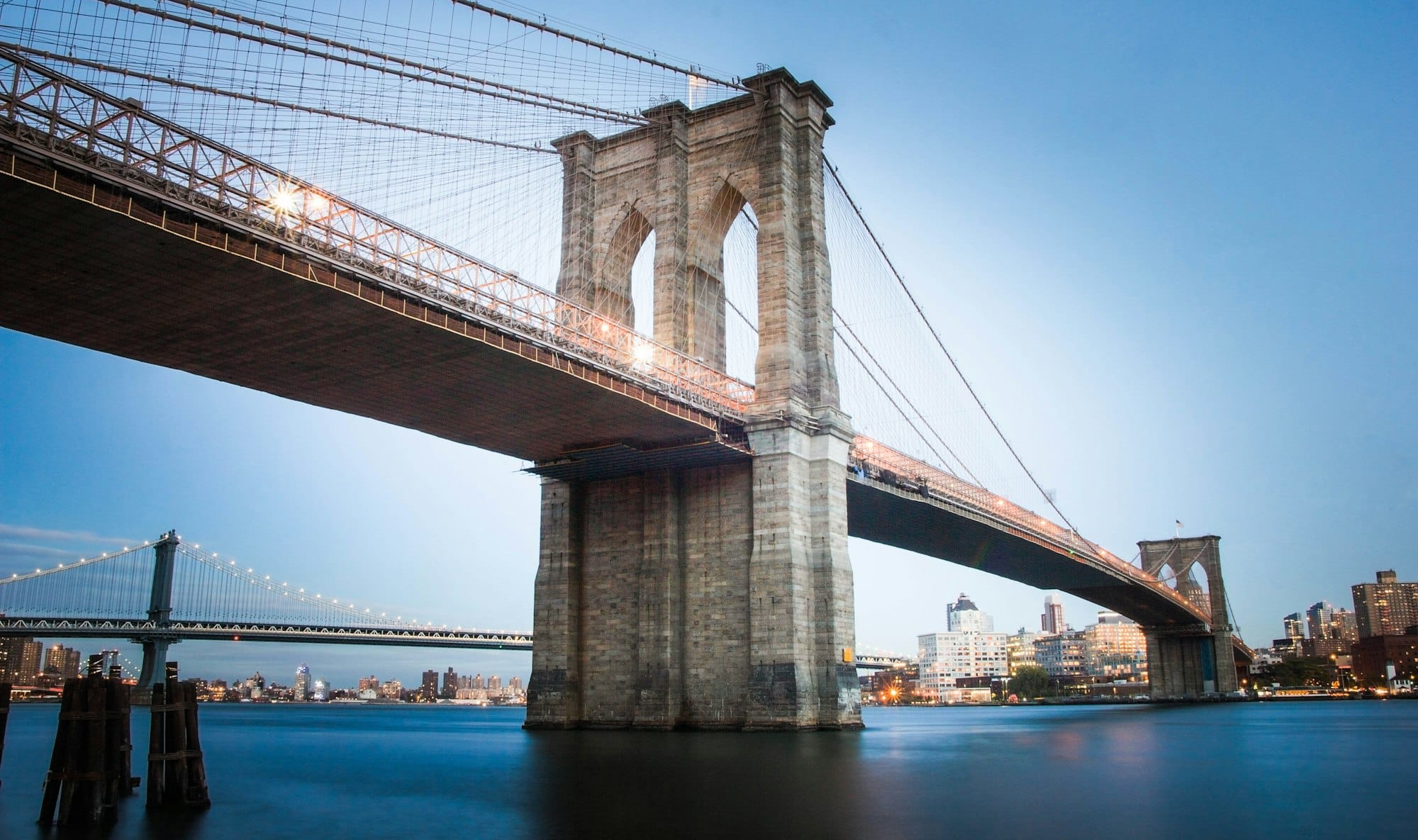
The Brooklyn Bridge connects Manhattan and Brooklyn over the East River. NYC DOT says construction ran from 1869 to 1883, the bridge was designed by John A. Roebling, the main span is 1,595.5 feet, and the total length with approaches is 6,016 feet. The bridge features two stone towers with pointed arches, which make it easy to tell apart from the steel bridges next to it.
- Walking: the raised pedestrian promenade runs above the traffic lanes, so you walk between the towers and under the cables.
- Biking: since September 2021 cyclists have their own two-way protected bike lane on the Manhattan-bound roadway, which took over one car lane. Ride in the bike lane, not on the promenade.
- Timing: the promenade gets crowded on weekend afternoons. Early morning is calmer, and the light on the Manhattan skyline is good at sunrise.
The walk fits well into a day in Lower Manhattan or Brooklyn. For more ideas, see our New York City bucket list.
Mackinac Bridge, Michigan
The Mackinac Bridge spans the Straits of Mackinac, where Lake Michigan meets Lake Huron, and links Michigan's Lower and Upper Peninsulas. It opened to traffic on November 1, 1957. The Mackinac Bridge Authority lists a total length of 26,372 feet, about 5 miles, and main towers 552 feet above the water. The Authority calls it the longest suspension bridge in the western hemisphere and the seventh-longest in the world by total suspended length.
- Driving: the passenger car toll is $4.00 ($2.00 per axle), with a 2.3% fee on card payments.
- Walking: there is no everyday walkway. The one chance to walk the bridge is the annual Labor Day Bridge Walk. In 2026 the bridge closed to public traffic from 6:30 am to noon, walkers started from St. Ignace or Mackinaw City after the governor's party set off at about 7 am, and no one could start after 11:30 am.
- Walk planning: the Authority provided no buses across the bridge in 2026, so end on the side where your car is parked. There are no restrooms on the bridge, and the walk takes about two hours on average.
Outside Labor Day, the shoreline parks in Mackinaw City and St. Ignace give you a full view of the towers and the straits.
New River Gorge Bridge, West Virginia
The New River Gorge Bridge carries US 19 high over the river gorge inside New River Gorge National Park and Preserve. The National Park Service says it was completed on October 22, 1977, after three years of work. It is 3,030 feet long, the steel arch is 1,700 feet, and the deck sits 876 feet above the New River. NPS calls it the longest steel span in the western hemisphere. It is not the tallest bridge in the country; NPS lists it as the third highest.
- Bridge Day: on the third Saturday of October the bridge closes to cars and opens to people on foot. It is the only day you can walk on top of the deck. NPS describes the day as views, vendors, music and watching BASE jumpers and rappellers go over the side; the first official Bridge Day was in 1980. Expect big crowds and road closures around the bridge.
- Other days: one authorized company runs 3-hour guided walks on the maintenance catwalk under the deck. Walking on top is not allowed outside Bridge Day.
- Seeing it from below or beside: the Canyon Rim boardwalk starts at the visitor center parking lot off US 19. A ramp leads to the first viewpoint and 178 steps drop to a lower overlook. Fayette Station Road, a mostly one-lane road, winds down under the bridge for a close view from below.
The park is also known for rafting and climbing. Our guide to US national parks covers more parks to pair with a bridge trip.
Royal Gorge Bridge, Colorado
The Royal Gorge Bridge near Cañon City hangs 956 feet over the Arkansas River, according to Royal Gorge Bridge and Park, which owns and runs it. The bridge was built in 1929 and is a bridge made for walking: the deck is 1,257 wooden planks. It is a suspension bridge, but unlike the others here it is a ticketed attraction, not a public highway.
- Getting on it: walking across is part of the park's general admission ticket, which also covers the park's other attractions.
- Hours and season: the park lists 9:00 am to 5:00 pm, open 365 days a year, weather permitting.
- Tip: the deck sits in an exposed canyon, so it can be windy. Wear shoes with grip; the planks have gaps you can see through.
Old Seven Mile Bridge, Florida Keys
The Old Seven Mile Bridge near Marathon in the Florida Keys was built for Henry Flagler's Overseas Railroad. The Pigeon Key Foundation says railroad construction peaked from 1908 to 1912, with about 400 workers living on tiny Pigeon Key, and the line to Key West was completed on January 22, 1912. The railroad ran until the Labor Day Hurricane of 1935, and the route later became a highway. Today's Seven Mile Bridge runs parallel to the old one.
- Walking and biking: a 2.2-mile stretch of the old bridge, from Marathon to Pigeon Key, reopened in January 2022 as a walking and biking path after restoration. No cars are allowed on it.
- Pigeon Key: admission is required to step onto the island, including its museum and restrooms. You can walk or bike out on the old bridge, or take the passenger train from the depot at 1090 Overseas Highway in Marathon.
- Tip: there is little shade. Go early, carry water, and watch the water below; the Foundation says visitors often spot rays and large fish from the bridge.
Tower Bridge, London, England
Tower Bridge crosses the Thames next to the Tower of London. Building work started in 1886 and the bridge opened to the public in 1894. It is a bascule bridge: the two halves of the road lift to let tall ships pass. Its high-level walkways, designed by architect Sir Horace Jones and engineer Sir John Wolfe Barry, sit 43.5 metres above the river at high tide and stretch 70 metres between the towers. They closed in 1910 because few people used them and reopened in 1982 as part of a visitor attraction.
- Walking: the road deck has sidewalks and is free to cross.
- Inside: the walkways have glass floor panels where you look straight down at traffic and the river. Entry to the towers, walkways and engine rooms is ticketed.
- Bridge lifts: Tower Bridge posts its lift times online, so you can plan to watch the bascules rise.
Charles Bridge, Prague, Czech Republic
Charles Bridge is a stone bridge over the Vltava River in Prague. According to Prague City Tourism, construction began in 1357 under Charles IV and finished in 1402. The bridge is 515.76 metres long and 9.5 metres wide, with 30 statues and statue groups on its railings. Cars stopped crossing in 1965, so it is now a walk with towers at both ends.
- Timing: the bridge is one of the busiest spots in Prague. Early morning is the quiet time to see the statues and the river.
- Getting there: it links the Old Town with the Lesser Town below Prague Castle, so it fits into a walking day across the city center.
Planning a bridge visit
- Check access the week you go. Sidewalks close for maintenance, events and weather. The bridge operator's website or social feed is the fastest way to find out.
- Know the toll rules. Many US bridges no longer take cash and bill by license plate. A rental car may add a fee on top of the toll, so ask at the counter.
- Dress for wind. Long spans over water or gorges are colder and windier than the shore. A hat with a strap and a light jacket help.
- Stay on the walkway. Do not stop on a roadway or shoulder for photos. Most bridges have a viewpoint or park at one end built for that.
- Plan the return. A one-way walk on a long bridge means you need a ride back or the stamina to walk it twice.
- Pick a bridge event if you like crowds. The Mackinac Labor Day walk and New River Gorge Bridge Day draw big crowds and need early starts and parking plans.
Sources: Golden Gate Bridge, Highway and Transportation District; NYC Department of Transportation; Mackinac Bridge Authority; National Park Service (New River Gorge National Park and Preserve); Royal Gorge Bridge and Park; Pigeon Key Foundation; Florida Keys and Key West tourism council; Tower Bridge; Prague City Tourism. Hours, tolls and event dates change; check the bridge operator before your trip.